Herons and egrets
All egrets are herons but not all herons are egrets. Most herons have long slender bodies, long legs and long sinous S shaped necks that bend into an S shape when resting or flying. Egrets are white herons and only came to the UK in 1996, naturally expanding from continental Europe due to warming climates.
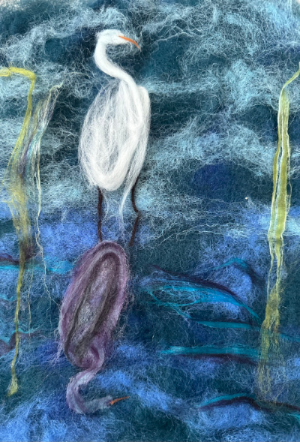
Egret and reflection - felt experimentation
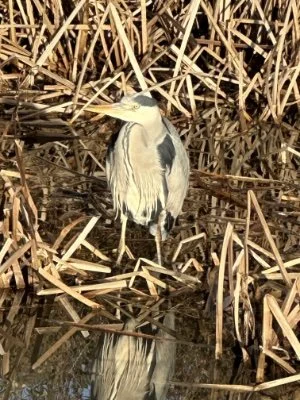
Grey heron stood patiently in the canal
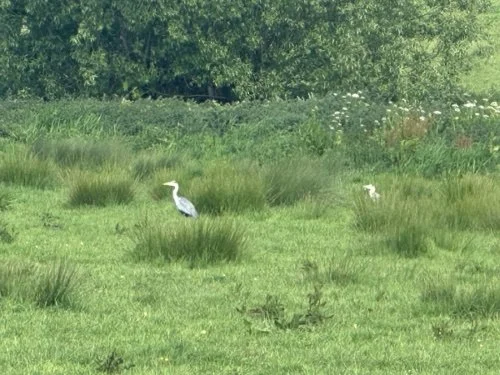
Herons visiting our local wetland
In celtic mythology the heron is associated with transitions and transcendance. In celtic art, herons are characterised as bridging the realms of earth, water and sky. In medieveal literature herons are associated with nobility and patience.
When herons take flight they bend their neck into their body.
Herons are opportunistic hunters - they eat fish, amphibians, small insects and even duckling. Egrets can sometimes be spotted foot stirring - disturbing the water to bring fish to the surface.
Kinds of writing
Guidebook, Nature journal, Poetry, Fable, Childrens’ story
Poetry - Robert McFarlane the lost words Heron, Mary Oliver egrets
Katherine Rundell - The Golden Mole
Herons are bio indicators of aquatic ecosystem health. They sit at the top of the food chain so monitioring their populations and nesting sites provides critical data regarding fish stocks heavy metal contamination and waterway quality.
How Water Quality Affects Herons
Food Availability: Herons rely heavily on clear, shallow waters to hunt fish, amphibians, and invertebrates. High water turbidity (cloudiness) or poor dissolved oxygen levels—often caused by agricultural runoff or excess nutrients—severely deplete natural fish stocks, which negatively impacts heron foraging and breeding success.
Contaminant Accumulation: Being apex predators, herons accumulate persistent organic pollutants, pesticides, and heavy metals (like mercury, lead, and arsenic) present in their prey. Scientists test heron feathers and tissues to measure these chemical concentrations and assess broader environmental pollution levels.
Herons establish heronries where they nest and breed - often in trees or in reeds.
They bond in different pairs each year.
Egyptian Bennu bird - considered prototype for the pheonix. Soul of Sun God Ra.
The Goddess Rhiannon: Herons are frequently associated with the Celtic/Welsh goddess Rhiannon. As a protector of lakes and waters, she is sometimes said to embody the heron, using the bird to help lost travelers find their way home.
Bridging Realms: Because they hunt in the shallows but soar high into the sky, Celtic traditions viewed the heron as a messenger between this world and the Otherworld. Spotting one often indicated you were standing at a spiritual crossroads.
Celtic heron knots